

During racing season, something important changes.
Over the next few weeks, I will be sharing videos I created that describe my latest discoveries in paddling and performance. Specifically, I will explain why getting paddlers to change their stroke pattern can be so frustrating for them. I have done a deep dive into this phenomenon, looking at every angle from the physiological, psychological and even the emotional, as I KNOW for 100% certainty that these paddling mechanics come into play when trying to create new habits that are part of our past limitations and paddling history.
HERE’S THE PROOF THAT CHANGE IS POSSIBLE:
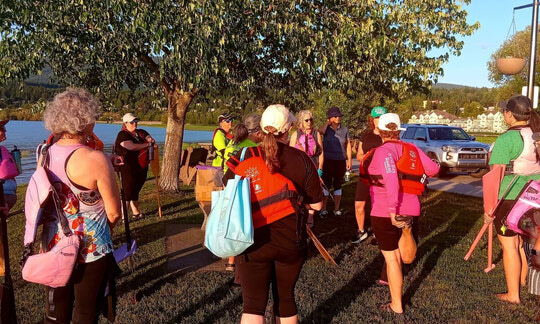
Last May at my technical drills and skills camp, I had paddlers from a few different clubs and teams attend. All different strokes. All different coaches. Some seasoned. Some brand-new paddlers. Some men. Some women. Some from highly competitive crews.
All different technical challenges.
This was my ultimate training ground… to bring together a crew of paddlers, using technical cues to see if I could blend the boat with body, blade, and stroke mechanics in just 9 short practices.
The first thing I did was to remove all performance expectations and bring a theme of “ease” to the training. I knew this would give their nervous systems a chance to calm down and their brains a chance to let go of preconceived expectations, making training camp fertile ground for change.
The second aspect I incorporated was rest. They were given at least 3 hours between sessions for integration. NOT the recovery that’s needed in a performance or spring camp, but the time needed for the nervous system to begin to let go of old patterns and incorporate the new ones…pure integration where mind and body catch up to each other, so the mechanics gains were lost. During this period, some did the meditation I provided, others socialized, and some just hung out. All were encouraged to focus on rest and allow their bodies and minds to reset.
The next thing I incorporated was curiosity through the senses of feeling, moving, and reorganizing, all while implementing aspects of the stroke. The mindset of learning was opened without the pressures of team demands to race and compete.
I provided video review, but it was in a “how can we learn from each other” setting rather than “this is what you're doing wrong”.
What I avoided was a lot of one-on-one coaching, as it can work in our favour or against us depending on the paddler's goals and intentions. Fixing a paddler’s stroke can make them feel like:
- they are somehow not connecting and therefore feel hopeless
- something is fundamentally wrong when they can’t make changes
- or frustrated that change doesn’t happen at the time of correction
So I avoided that aspect. In team settings like a performance clinic, this is the energy, but at this camp, with paddlers across a range of paddling experience, the focus was on learning and development.
The last thing that I allowed was internal integration. I opened the door for paddlers to explore their own learning styles and work on stroke mechanics without having to learn a team’s stroke in team practice.
THE RESULTS:
At session 9, when these paddlers were amped and ready to put their skills to use in intense pieces at higher rates, they reached 12.1km/hr and held it for over 10 seconds, with a full 90-second held rate of 10.2km/hr.
Now that’s success.
So over the next few weeks, I will share my findings and strategies for how we can approach training and development of stroke, body, and blade mechanics so that paddlers really integrate the information that produces results.
FLOW:
I will also share my experience of my “force,” not “flow,” mentality and how that caused me stress, injury, and frustration, and how, with a new intelligence system, I am helping other paddlers not overtrain, not burn out, and bring back the love of sport…while getting wicked fast!
RECOVERY ADAPTATIONS:
I will provide evidence of how the drive of my youth, along with my mindset, led to some of the injuries I am struggling with in my 60s, and of the adaptations I have made to my training and recovery to regain the vitality of paddling I felt in my youth.
These shifts are real and are manifesting as new ways of seeing my body and respecting the wisdom and confidence that come with being in this sport for over 25 years, which are leading me.
WHAT FLOORS ME:
All the ambition and drive is still part of me, but the disciplines have shifted to honouring where I am at rather than forcing myself to be something I no longer am.
So whether you are experienced or new to paddling, try some of my concepts, mindsets, and internal regulation strategies to help you learn more healthful and helpful training methods that are just BETTER than what you did before.
P.S. Stay tuned as I share the strategies as I head to Canada’s west coast to shave seconds off a crew’s time in a high-performance clinic!
P.S.S. And in late September, I will dive deep into the disciplines of recovery. I will share how to incorporate the performance mechanics of nervous system recovery and regulation and how they are used in training and in competition!
Find the course or program
|